

Pole Dancing as Somatic Therapy
A personal exploration of why my healing required movement, not more thinking

I wasn’t expecting to cry.
Not in a dance studio full of mirrors.
Not surrounded by women cheering and clapping for me.
And yet, there I was.
Suddenly close again to a heartbreak I thought I had already moved through.
Time felt like it folded in on itself, carrying me back to a familiar heaviness. Grief I hadn’t processed, just tucked away beneath the work, events, and shopping I’ve been outsourcing as a distraction.
Getting back to dancing became the key that unlocked it.
Unexpectedly, but necessarily.
That moment made something very clear to me: I needed to be more intentional about returning to the movement I once loved as a child. Specifically, dancing and tennis. I was intentional about choosing practices that felt in sync with my energy instead of forcing my body into routines that drained me or dulled my creativity. Movement that encouraged me to enter a flow state, where my nervous system could soften and long-buried emotions could rise to the surface, is what I desired.
What I later realized was that I wasn’t just exercising, I was engaging in somatic therapeutic work. Somatic therapy is a body-centered approach that recognizes how trauma, stress, and challenging emotions are stored in the body. At that very point in my tennis practice, I lost count of the number of times I imagined a tennis ball as an ex’s head. I used to unleash every ounce of anger and frustration on those courts. But what mattered most was this: movement always brought me back to acceptance instead of chaos. To release instead of crashing out. It brought me back to my center, back to me.
Our bodies are our oldest and wisest companions. They speak truths that words can’t always express. Body language reveals what goes unsaid, and actions expose what stories try to mask. It’s when we lean into the body’s wisdom with curiosity rather than fear that we open a doorway to deeper self-awareness and healing. Yet emotional awareness is often undervalued in today’s society. What’s labeled as “too sensitive” is often the very skill that helps us recover from traumatic events. Being courageous in befriending our bodily sensations is how we learn to regulate ourselves, and not repress. What’s beautiful is that this ability isn’t rare. It’s innate. No one is exempt from activating it.
In The Body Keeps the Score, Bessel A. van der Kolk writes, “Individuals who lack emotional awareness are able, with practice, to connect their physical sensations to psychological events. Then they can slowly reconnect with themselves.” This confirms that the mind can be reeducated to feel, and the body can be supported in tolerating and identifying those sensations to make decisions from an empowered place. This is why somatic practices matter. Healing isn’t always cognitive. Dance Movement Therapy, yoga, and mindful motions restore flow where stagnation once lived. They allow us to inhabit our bodies without being overtaken by the imprints trauma left behind. Instead of pushing through or disconnecting, we begin rewiring ourselves toward honesty, acceptance, and self-trust.
This idea of returning to the body isn’t new. I remember seeing it play out in a sitcom episode that stayed with me for years. The episode of The Fresh Prince of Bel-Air where Aunt Viv, burnt out and having a midlife crisis, returns to dance (her first love). When she showed up for the final audition, she outshone the younger dancers who mocked her for her age and looked damn good doing it! Witnessing her reclaim her power through movement felt deeply familiar.
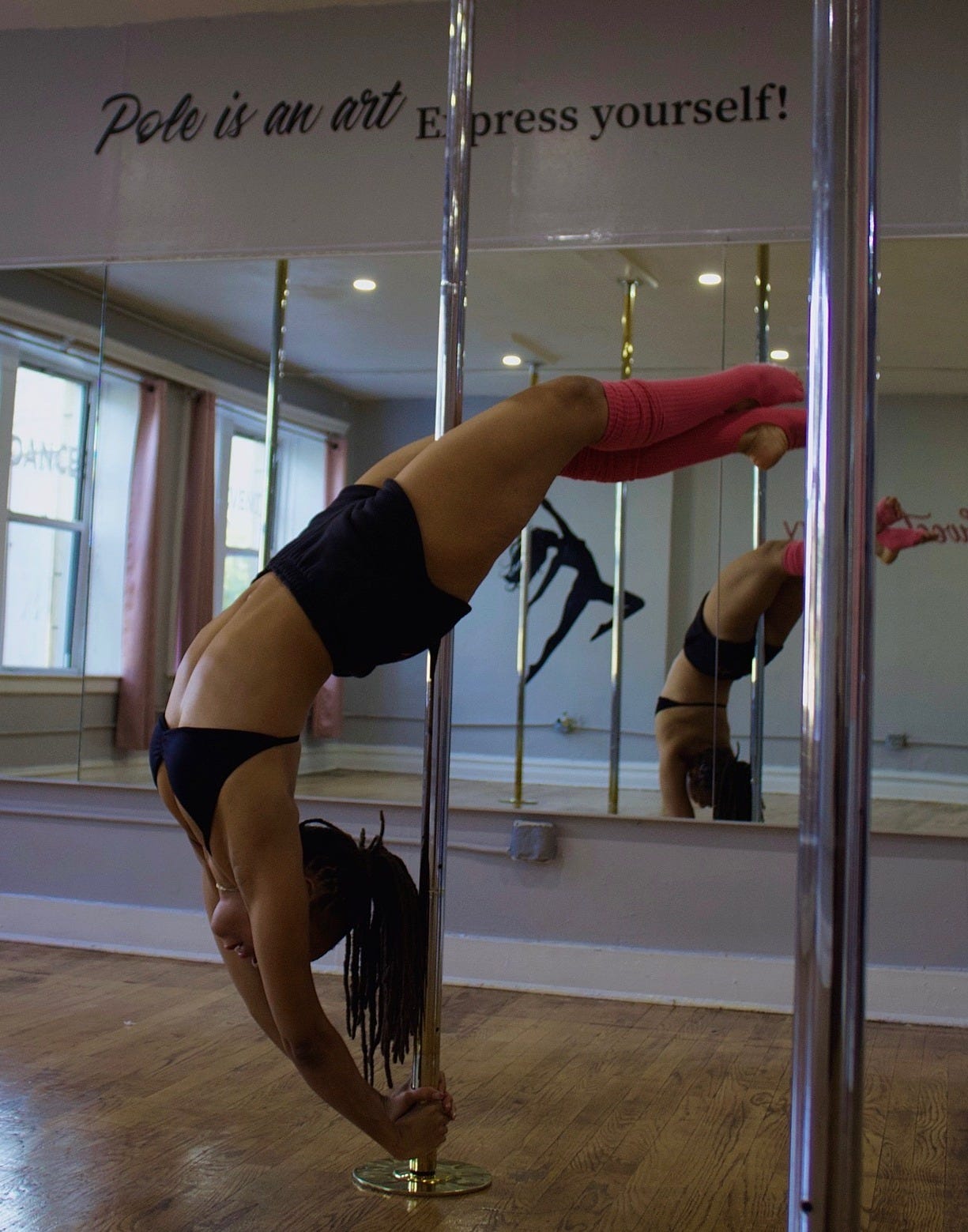
When I recommitted to consistent movement, especially pole dance fitness, I found myself back in a flow state. Pole demands presence, patience, and vulnerability. It carries a divine feminine energy that blends strength and sensuality seamlessly. Here, my movements felt both powerful and soft. And my self-confidence grew not from performance, but from trust.
Having a safe space to move (especially to open my hips, often called the body’s emotional junk drawer) unlocked emotions I didn’t have the language or support to process at the time. In somatic therapy and yoga philosophy, the hips are known to store fear, grief, and shame. No wonder tears came up for me in my first few Intro to Pole classes. I was being reminded that my body remembers what my mind tries to forget.
If you’ve been feeling disconnected, burnt out, or numb, I invite you to notice where your body might still be holding something your mind has already moved past. Maybe healing doesn’t require more thinking. Maybe it simply asks you to move.
SOMETHING TO PRACTICE…
Your presence here tells me you’re open to listening more closely, to slowing down, and to tending to yourself. I want to offer you a simple practice you can return to whenever you feel overwhelmed or disconnected.
Find a few uninterrupted minutes (3–5 is enough).
Put on a song that feels meditative or familiar.
Stand or sit comfortably. Take three slow, deep breaths.Begin to move your hips gently in small circles and/or soft sways (3x clockwise and counterclockwise).
Then pause. Find stillness that feels safest for you.Notice what arises.
Warmth. Tightness. Heaviness. Ease.
Let your body lead without asking it to explain itself.If a memory, feeling, or tear surfaces, simply acknowledge it.
Your body isn’t asking to be analyzed. It’s asking to be witnessed.When you’re ready, place one hand on your lower belly and one on your heart.
Inhale deeply, feeling the cool air enter through your nose.
Exhale slowly, feeling the warm air leave your mouth.Bring your awareness back to the present moment.
Offer gratitude to the practice, and to yourself.
This is what internal maintenance can look like.
Brief. Intentional. Rooted in care. You don’t need perfection, just presence.
Thank you for being here with me.
And for choosing, again and again, to come home to yourself.
Cx